
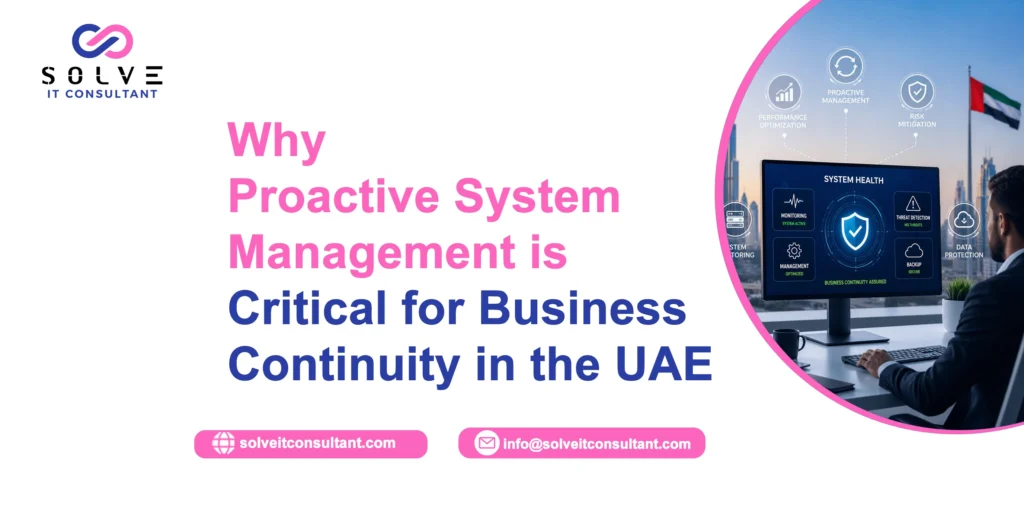
In the UAE’s fast-moving business mood, technology is not really just a helper thing anymore—it’s more like the core way day-to-day work gets done. Organisations lean on cloud platforms, business applications, networks, servers, cybersecurity tools, comms systems, and digital payment infrastructure to serve customers and also keep internal routines moving. When those systems unexpectedly act up, even a short hiccup can quietly shake productivity, revenue, customer confidence, and business reputation at the same time, or almost.
So yeah, that’s why proactive system management keeps getting more important for companies across the UAE. Proactive management keeps systems under constant watch, spots possible threats early, maintains infrastructure health, applies updates, and addresses weaknesses before they escalate into major disruptions. For businesses aiming to boost business continuity, this kind of approach usually brings more steadiness, better defence, and stronger operational resilience.
What Is Proactive System Management?
Proactive system management is basically this kind of approach where an IT infrastructure is monitored, maintained, and improved continuously so troubles can be prevented before they end up interrupting business operations. Instead of only acting after a server goes down, or the network stops behaving properly, or a security incident shows up, IT teams look for early warning signals and then handle them ahead of time.
This can include system monitoring, tuning performance, security patching, backup administration, network watching, hardware care, software updates, vulnerability management, and routine IT health checks. The aim is kind of simple: keep key technology systems running, secure, and dependable so employees can work without surprises that slow everything down.
For UAE businesses, this method is especially useful because lots of organisations work in spaces that are fiercely competitive and digitally connected. Like, a technical hassle that stops customer service, online transactions, everyday communication, or even internal work can turn into an actual business crisis real fast.
Why Business Continuity Matters for UAE Businesses
Business continuity basically means you can keep the vital operations moving even when the unexpected disruptions hit. These interruptions might be IT breakdowns, cyberattacks, hardware failures, software troubles, network outages, power interruptions, or other operational problems that pop up without warning.
The UAE has built a strong digital commerce ecosystem, and companies in many sectors increasingly rely on technology. From financial services and retail all the way to logistics, healthcare, hospitality, real estate, and professional services, tech supports key business routines every day.
And the longer the outage lasts, the bigger the impact on both productivity and income. With proactive system management, businesses can lessen these risks by spotting and correcting technical issues before they grow into something much larger; honestly, it’s kind of about being ahead of the curve.
-
Preventing Unexpected IT Downtime
A big advantage of proactive system management is how it helps reduce sudden downtime. Traditional IT support usually leans toward repairs after issues show up, so staff may just stand by while systems are brought back, and nobody really loves that waiting time.
Proactive monitoring helps IT teams spot strange system behavior early, like storage pressures, network slowdowns, hardware warnings, and other telltale signs that typically come before a bigger failure happens.
For example, if a server is getting close to its storage limit, proactive monitoring can catch it early, like before it turns into a messy situation. IT teams can expand storage, sort out unused data, or fine-tune the environment a bit before the server starts acting unstable. In this way, you can dodge an interruption that was basically preventable, and business operations stay steady
-
Spotting problems before they turn into bigger issues
Little technical things can slowly, almost quietly, grow into bigger IT incidents when they are ignored. A sluggish application, repeated network disconnections, an older software component, or a hardware unit that begins failing might seem minor at first, more like background noise
Still, those early warning signals can hint at deeper infrastructure trouble. With proactive system management, teams keep looking for these cues, so IT professionals can investigate sooner, rather than waiting until it becomes a pricey collapse
This kind of shifts IT’s work from “fix it after it breaks” toward preventive risk management. Instead of asking, “Why did the system fail?” businesses can ask, “What can we do right now so failure doesn’t happen?”
-
Improving Cybersecurity
Cybersecurity is one major reason UAE businesses need proactive system management too. Cyber threats hunt for outdated software, weak configurations, unpatched vulnerabilities, leaked credentials, and poorly guarded networks.
Regular system monitoring and maintenance can help businesses spot vulnerabilities and security weaknesses before attackers use them. Putting security patches in place, updating software, checking access permissions, observing odd behavior, and keeping secure settings maintained are key pieces of proactive IT management in real life.
-
Protecting Business Data Through Reliable Backups
Data is honestly one of the most valuable assets for modern organizations. Customer details, financial records, contracts, staff information, operational documents, plus business databases might all live digitally now.
A hardware failure, a ransomware incident, accidental deletion, or even a software malfunction could make important data unreachable. Proactive system management means checking the backup processes and also verifying regularly that those backups are truly working.
Just having a backup system isn’t enough. A dependable backup and recovery strategy can greatly increase an organization’s ability to restart operations after something goes wrong.
-
Improving System Performance and Employee Productivity
IT issues don’t always mean full system breakdown. Slow computers, inconsistent applications, weak network performance, and recurring technical errors can quietly drain employee output over time
Employees may end up spending those valuable working hours just waiting for applications to load, or reconnecting to networks, or even dealing with repeated technical problems—kind of the same cycle again and again. Little interruptions like that, over time, add up and can turn into pretty major productivity losses.
Proactive system management basically keeps checking how the system is doing, and it surfaces which parts need optimization. When the infrastructure stays healthy, companies are usually able to give staff more dependable tools and also reduce the time wasted on avoidable technical issues, even when the problem seems “small” at first.
-
Supporting cloud and hybrid work environments
A lot of UAE businesses now lean on cloud-based applications and hybrid IT setups too. Staff members can reach business systems from offices, home, different branches, or sometimes from mobile devices, which sounds convenient but brings its own stuff.
Cloud tech brings flexibility and scalability, but it also means you’re managing extra systems that have to be monitored and secured. Things like misconfigured cloud resources, access issues, service interruptions, or security vulnerabilities can start affecting operations, sometimes suddenly.
Proactive management helps organizations keep an eye on cloud environments, revisit access controls, keep configurations in a good state, monitor performance, and spot potential issues before they become urgent. That matters even more for companies that depend on cloud applications for communication, collaboration, customer management, accounting, or other essential functions.
How Proactive System Management Works
An effective proactive system management strategy usually runs in a continuous loop, more like a rhythm than a one-time maintenance schedule.
- Monitoring has to happen. IT systems, networks, servers, endpoints, applications, and other critical infrastructure are watched for odd behavior, performance hiccups, and signs of potential failures. Sometimes the “signal” is subtle, so teams look for it consistently.
- Maintenance takes over. Software updates, security patches, configuration improvements, hardware checks, and a bit of performance optimization are carried out on a regular basis. The goal here is to keep things steady, not just react when something breaks.
- Risk assessment, which sort of maps where the trouble could show up first. By spotting vulnerabilities early, IT teams can evaluate their environments and prioritize the work based on expected business impact, not just on urgency.
- Backup and recovery management also matters, because important data and key systems need a reliable path back if something goes wrong.
- Continuous improvement ties it all together. Organizations learn from incidents, system performance, and shifting business requirements. In practice, this means the IT infrastructure evolves along with the organization, even when the business changes midstream.
Why UAE Businesses Should Take a Proactive Approach
The modern UAE business environment tends to favor organizations that can run efficiently, securely, and in a steady manner. Technology plays a key part in reaching these targets, but at the same time it also introduces fresh operational risks when systems are not cared for properly.
With proactive system management, businesses can spot risks much earlier, maintain infrastructure in a more effective, almost disciplined way, strengthen cybersecurity, protect critical data, and minimize those annoying, unnecessary slowdowns or shutdowns. It also helps business leaders get a clearer view into how well their IT environment is actually performing day to day.
Instead of treating IT management like it’s only a cost center, companies can see it as an investment in operational resilience. When the IT foundation stays stable, employees have the tools they need to work efficiently, and organizations can respond with more confidence if something unexpected happens, even if it’s outside the usual routine.
Conclusion
Proactive system management matters a lot for business continuity in the UAE, because modern businesses cannot really afford to rely on technology only when everything is behaving perfectly. Continuous monitoring, preventive maintenance, cybersecurity, backup management, performance optimization, and disaster recovery planning can help reduce both the chance and the potential impact of IT disruptions.
For UAE businesses, the aim should not only be to recover quickly after a failure. The better direction is to identify risks early, stop preventable problems, and build an IT infrastructure that supports uninterrupted business operations. When organizations adopt proactive system management, they can improve reliability, safeguard valuable data, tighten security, reduce downtime, and create a more resilient base for long-term growth.